Lake Trout EpiGenomics Project
From Methylation & Structural Variation to Candidate Genes — Salvelinus namaycush Ecotypes
Note: The published landing page (
index.html) is a hand-authored, self-contained page. This.qmdmirrors its content as the editable source. If you re-render with Quarto, review the result againstindex.htmlbefore publishing so the polished layout is preserved.
Two Ecotypes, One Lake System
Lake trout (Salvelinus namaycush) in the Great Lakes occur as divergent ecotypes that share water but not lifestyle:
- Lean: shallow-water dwelling, elongate body, low lipid content
- Siscowet: deep-water specialist, robust body, high lipid storage
This project asks a focused question: which genes carry the epigenetic and structural differences between the ecotypes, and what phenotypes might they shape? Earlier stages produced the raw differences — differentially methylated regions (DMRs) and presence–absence variants (PAVs). The work featured here adds the missing interpretive layer: a genome-wide functional annotation that turns coordinates into gene names, products, and Gene Ontology terms, then ranks candidates and reasons — carefully — about phenotype.
Read this as hypothesis-generating. Every link below is an association on a single lean-background reference genome — no functional validation, and no single CpG survives genome-wide multiple-testing correction. The value is a ranked, annotated shortlist, not a causal claim.
How the Evidence Stacks: Three Integrated Layers
Differential methylation
- 540,040 CpG sites tested
- 302 DMRs (20 hyper- / 282 hypo-methylated in siscowet)
- 149 DMRs within 5 kb of a gene; 88 in promoters
- 0 single CpGs survive q < 0.1 — lead with the DMR level
Presence–absence variation (PAV)
- 3,465 stringent siscowet-specific deletions (>100 bp, all-4-vs-none)
- 1,543 within 5 kb of a gene; 54 overlap an exon (candidate copy/LOF changes)
- Reference-bias aware: a lean-background genome inflates siscowet deletions
Functional annotation (new)
- 46,359 genes annotated from NCBI RefSeq
- 46,231 with a product description; 34,367 with ≥1 Gene Ontology term
- The join key that turns variants into interpretable candidates
See analyses/18-annotation/README.md for the annotation methods and provenance.
Convergent & Top-Ranked Candidate Genes
Genes were ranked by convergence (methylation and deletion), promoter/exon placement, expression support, and methylation↔︎expression concordance. The four convergent loci — carrying both a DMR and a high-confidence siscowet deletion — are the strongest candidates.
| Gene | Product | Methylation | Deletion | Note |
|---|---|---|---|---|
znf883-like (LOC120032414) |
Zinc finger protein 883-like | exon · hyper | exonic | top convergent |
XlCGF57.1-like (LOC120040411) |
Gastrula zinc finger protein XlCGF57.1-like | intron · hypo | nearby | convergent |
septin-9-like (LOC120043843) |
Septin-9-like | intron · hyper | nearby | convergent |
| LOC120039781 | Uncharacterized locus | intron · hypo | nearby | convergent |
angptl5 |
Angiopoietin-related protein 5-like | — | exonic | lipid axis |
mogat2 |
2-acylglycerol O-acyltransferase 2-A-like | — | exonic | lipid axis |
ephx1-like |
Epoxide hydrolase 1-like | promoter | — | lipid / xenobiotic |
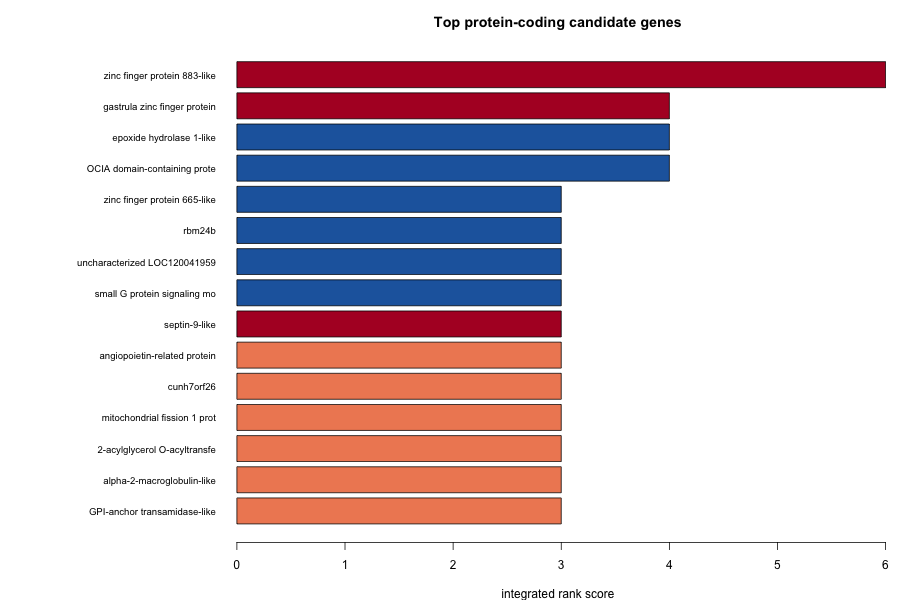
Source: integrated_candidate_genes.tsv.
Gene Ontology enrichment (deletion set)
| GO term | Fold | FDR | Read as |
|---|---|---|---|
| Calcium ion transmembrane transport | 3.7 | 5.6×10⁻⁴ | most defensible signal |
| Neuron projection development | 2.4 | 2.6×10⁻³ | sensory / neural |
| Calcium channel complex | 4.6 | 3.0×10⁻³ | length-bias caveat |
| Calcium ion transport | 3.0 | 3.0×10⁻³ | ion homeostasis |
| Lipid / phospholipid binding | 1.5 | ns (0.3) | suggestive only |
Hypergeometric over-representation vs. all GO-annotated genes (BH-FDR). The DMR set’s enrichment is dominated by a single histone cluster and adjacent znf883 paralogs — a tandem-cluster artifact, not broad convergence. Full tables: PAV, DMR, union.
Hypothesized Links to Ecotype Biology
Each axis pairs annotated candidate genes with a known or measured difference between the ecotypes. These are hypotheses anchored to morphometric data, not validated mechanisms.
- 🫧 Lipid & energy storage — exonic siscowet deletions in
angptl5,mogat2, and a promoter DMR at epoxide hydrolase 1 touch lipid handling, consistent with the defining high-lipid siscowet phenotype and deep-water buoyancy. - 🐠 Body shape, growth & muscle — methylation-led candidates including
rbm24b(muscle/cardiac splicing) and growth-associated GO terms align with the elongate-lean vs. robust-siscowet contrast captured in the 17-landmark morphometric data. - ⚡ Calcium / sensory-neural — calcium-transport and neuron-projection GO enrichment in the deletion set hints at sensory or excitability differences relevant to a deep, dark, high-pressure habitat (length-bias-aware).
- 🛡️ Immune & adhesion — exonic deletions hit immune/adhesion genes (alpha-2-macroglobulin, CEACAM, DMBT1); some signal is real divergence, some reflects rapidly evolving, reference-divergent families.
Full write-up: code/18-diff-annotation-phenotype.html.
Interactive Genome Browsers
Explore methylation, PAV, gene, and ecotype-synteny tracks directly across the SaNama_1.0 assembly. Genes now carry functional annotation (symbol, product, GO terms, and which ecotypes retain them), and lean/siscowet synteny blocks are projected onto the reference so you can see, at any locus, which ecotype contig maps there and whether it is inverted.
🔬 IGV.js — quick exploration
Functionally-annotated genes · lean & siscowet synteny blocks · PAV insertions & deletions · CpG methylation (8 samples) · DMRs
🧬 JBrowse 2 — advanced analysis
Functionally-annotated genes (GFF3) · lean & siscowet synteny blocks · PAV structural variants · CpG methylation · differential methylation · lean ↔︎ siscowet Linear Synteny View
For the side-by-side ecotype comparison, open JBrowse’s Linear synteny view and pick the lean_purged and siscowet_purged assemblies with the Lean ↔︎ Siscowet synteny track.
Interpretation Guardrails
This analysis is deliberately conservative. The constraints below shape every claim above and are baked into the candidate rankings.
The reference is a lean-background genome. SaNama_1.0 was built from a doubled-haploid Seneca Lake (lean-morphotype) fish. Siscowet diverges more from it, so siscowet reads map less completely — inflating apparent siscowet-specific deletions and reducing methylation power in the most divergent regions. Siscowet and lean variant counts are not magnitude-comparable.
No single CpG survives genome-wide correction (0 DMCs at q < 0.1). Interpretation leads with DMR-level and stringent-PAV sets; single-CpG and lenient-PAV hits are hypothesis-generating only.
Expression support is weak by design. The liver RNA-seq is from a separate parasite study with different individuals — orthogonal support, never confirmation.
Enrichment confounders. The PAV GO signal carries a gene-length bias (long calcium/ion-channel genes accumulate deletions by chance); the DMR GO signal is a tandem-cluster artifact. Associations, not causation — no functional validation was performed.
Data & Methods
Reference Genome
- Assembly: NCBI GCF_016432855.1 (SaNama_1.0)
- Source: NCBI BioProject PRJNA674328
- Annotation: NCBI RefSeq GFF + GO (GAF)
Samples
| Ecotype | Sample Size | Description |
|---|---|---|
| Lean | n=4 | Shallow-water ecotype (PacBio HiFi) |
| Siscowet | n=4 | Deep-water ecotype (PacBio HiFi) |
Analysis Pipeline
- PacBio HiFi sequencing with 5mC modification calling
- CpG methylation profiling & DMR identification
- Coverage/CIGAR-based PAV detection (lenient + stringent tiers)
- RefSeq functional annotation backbone (gene → product → GO)
- Strand-aware DMR/PAV-to-gene assignment (promoter ±2 kb, flank ±5 kb)
- Hypergeometric GO over-representation with BH-FDR
Citation & Resources
- GitHub Repository: RobertsLab/project-lake-trout
- Annotation plan:
code/18-diff-annotation-phenotype-plan.md